
Hi, I’m Adam Cohen.
Welcome to my blog about what design means, and what it means to design.
Explore the latest posts

When Value Engineering Wins, Everyone Loses
“If we make nice details the driver, we’re going to lose control of the project.” I was stunned. Losing control? That wasn’t a concern I’d heard voiced so early on any project I’d worked on before. After all, we were the architects — weren’t we the ones in charge? Why was our partner +…
Keep reading
Using easter eggs to get through dull work
Parts of the design process can feel thrilling and glamorous, but in most jobs and in all studios, the bulk of the work is rather mundane. The Guggenheim in New York shattered norms on a grand scale, yet the daily tasks undertaken by drafters, junior architects, and consultants involved were largely indistinguishable from any…
Keep reading
Wish fulfilment
Whenever we design something that occupies an experiential genre or links to an existing IP, our success hinges in large part on our ability to negotiate something called wish fulfilment. As Curtis Hickman writes in his VR Storytelling manual Hyper-Reality, people who pay to take part in a Ghostbusters-branded experience are going to be…
Keep reading
White train stations and wishful thinking
In an era of advanced visualization tools, it’s easy to create startlingly clear renderings of proposed projects. The danger to designers and their clients is that the realism these tools offer belies the complexity and challenges imposed by the real world. If the things we design don’t take reality into account, they’re unlikely to…
Keep reading
10 (21st-century) principles for good design
Back in the late 1970s, Dieter Rams coined his famous 10 principles for good design. Apparently, it was always Rams’ intent that these principles would be re-evaluated and updated by future generations, and I’ve decided to take him up on the challenge. Over the last 50 years, the world has changed a lot, and…
Keep reading
Three-dimensional space and information processing
Last week I had the opportunity to visit some of the extraordinary Smithsonian museums in Washington D.C. One of the big takeaways for me was the fact that our experience of architectural space has a huge effect on our ability to make meaning out of information. When the internet came along, I think a…
Keep reading
Peril and positive feedback loops
Positive feedback loops are powerful tools. For designers aiming to create change at scale, they can be hard to resist. A positive feedback loop occurs when an effect perpetuates and amplifies itself. Despite its name, it’s not always a good thing. When a microphone and speaker are caught in a positive feedback loop, they…
Keep reading
The skeuomorphism cycle
Relative to its power and capability, the original iPad was probably one of the most intuitive pieces of technology ever designed. People who had never been comfortable with computers learned to use it with remarkable ease. Part of the reason it was so successful was that the software made extensive use of a technique…
Keep reading
Let’s fix the application portfolio
Almost every design school I’m aware of requires applicants to submit a portfolio of creative work. Most prospective students interpret this as a call for fine art. When the tradition of portfolios began, this type of work was probably a useful indicator of a student’s prospects for success. After all, until relatively recently, design…
Keep reading
Misdirection is a tool
The design of human interfaces and the design of stage magic have a fascinating common quality: They both engage with the brain’s capacity for internalizing stories about the link between cause and effect. When designers of either kind do their jobs correctly, they control that story in a way that delivers value to the…
Keep reading
Getting smarter about weakest links
A few years ago, a seemingly insignificant fracture in a tiny plastic switch mechanism condemned one of my family’s lamps to the garbage heap. Despite the overall robustness of the product, this minor defect rendered it utterly useless. The most tragic part? That tiny piece of plastic probably cost pennies to manufacture. Every product…
Keep reading
Kew Gardens, foresight, and the gift of time
A colleague recently introduced me to a fascinating concept from the world of project management. It can be encapsulated through an eccentric analogy coined by Fred Brooks: It takes a woman nine months to make a baby, but you can’t expect nine women to make a baby in a month. Some projects have components…
Keep reading
“Head-of-the-firm designers” and the future of authorship
I recently had a great conversation with a friend of mine about design authorship in the context of generative AI. Her point of view was that a designer can’t claim a project as their own if AI was used to come up with the core concept. That’s hard to argue with. What’s fascinating is…
Keep reading
People aren’t wasps
Many designers try to solve problems by changing how people behave. On the surface that makes sense. We wouldn’t have litter if you could stop people from throwing trash on the ground. The challenge, as Buckminster Fuller has described, is that people don’t respond well to being told what to do. We can make…
Keep reading
My non-fiction book recommendations 2023
I’ve been asked a lot lately for recommendations on non-fiction reading. To mark the solstice, I’ve decided to start a list of my favourite titles. I’ll update it annually going forward. My quest whenever I read is to answer two fundamental questions: How does the world work? What tools can I use to help…
Keep reading
Turns out we’re up first. Now what?
The creative industries are changing fast. Three years ago everyone thought this would be the last area that computers would automate. Turns out we got it wrong. We’re actually up first. What’s kind of striking is the degree to which a lot of young people seem to be proceeding with a fairly business as…
Keep reading
Design isn’t the product
Henry Ford’s Model T didn’t change the world because it was a well designed car. It changed the world because it was produced through a well designed system. Had Ford sought to build an affordable car by refining the vehicle itself, there’s no way he would have been able to deliver something at a…
Keep reading
The three dimensions of affordability
Some people consider affordable a synonym for cheap, but I think it’s a word with a lot more nuance. Rather than a price tag, I see affordability as a holistic measure of feasibility given our goals and resources. In my opinion, true affordability lies at the intersection of the function, cost, and timeframe that…
Keep reading
Great ideas and spotting deer
Thinking up a great idea is a little like spotting a deer. They’re elusive enough that discovering one is always big news. The key to increasing your chances is actually visiting their habitats. There’s no guarantee that you’ll see a deer on any given hike through the forest, but you certainly won’t find one…
Keep reading
Red Delicious design school
The Red Delicious apple, while aesthetically pleasing, has become a classic example of the trade-off between beauty and quality due to years of selective breeding for appearance. This post isn’t about apples, but about a trend I’ve observed in the architecture school I attend, which seems to follow a similar path: the overemphasis on…
Keep reading
Broken mirrors and broken windows: contrasting forms of decay
Broken mirrors and broken windows may seem similar upon first inspection, but the consequences of leaving the latter unaddressed can be dramatically more severe. This is because decay comes in different forms. Some decay is benign, while other decay is metastatic, spreading and growing at an exponential rate if not promptly attended to. The…
Keep reading
Notice with balance
Tony Fadell, a key force behind Apple’s iPod once explained that the secret to design innovation is noticing the problems that most people overlook. The fruit sticker for instance is a daily nuisance for millions, but it’s become so ubiquitous that almost everybody just accepts it as a fact of life. Fadell believes that…
Keep reading
Availability bias and choosing important projects
If you believe in focusing on high leverage projects, you need to get familiar with availability bias. Availability bias describes the mind’s tendency to equate how frequently we see something with how common and important it must be. Thanks to mass media, the things we see most often aren’t the things that happen most,…
Keep reading
AI and the Theme Park of Tomorrow: Personalized Adventures and Dynamic Storytelling
Environmental storytelling is a technique used by theme park designers to create immersive worlds where “the audience” discovers narratives through independent exploration of 3D environments. Notable examples include Disney’s Star Wars: Galaxy’s Edge and Universal Studios’ The Wizarding World of Harry Potter. While this art form can be incredibly engaging, it currently has limitations…
Keep reading
Temperature-bunkers: A pragmatic alternative to full-building retrofits
As extreme heating and cooling events become more common in the coming decades, we’ll need to find new strategies for keeping everyone comfortable while minimizing emission of additional greenhouse gasses. The biggest challenge we face is that most buildings are poorly insulated — and that means mechanical heating and cooling is an extremely inefficient…
Keep reading
Handling Corners
It’s often said that you can tell a lot about an architect’s skill and experience level by the way they handle their corners. Corners are challenging to design because they’re the place where different strategies and patterns meet. If one side of your building is clad in wood, and another is clad in stucco,…
Keep reading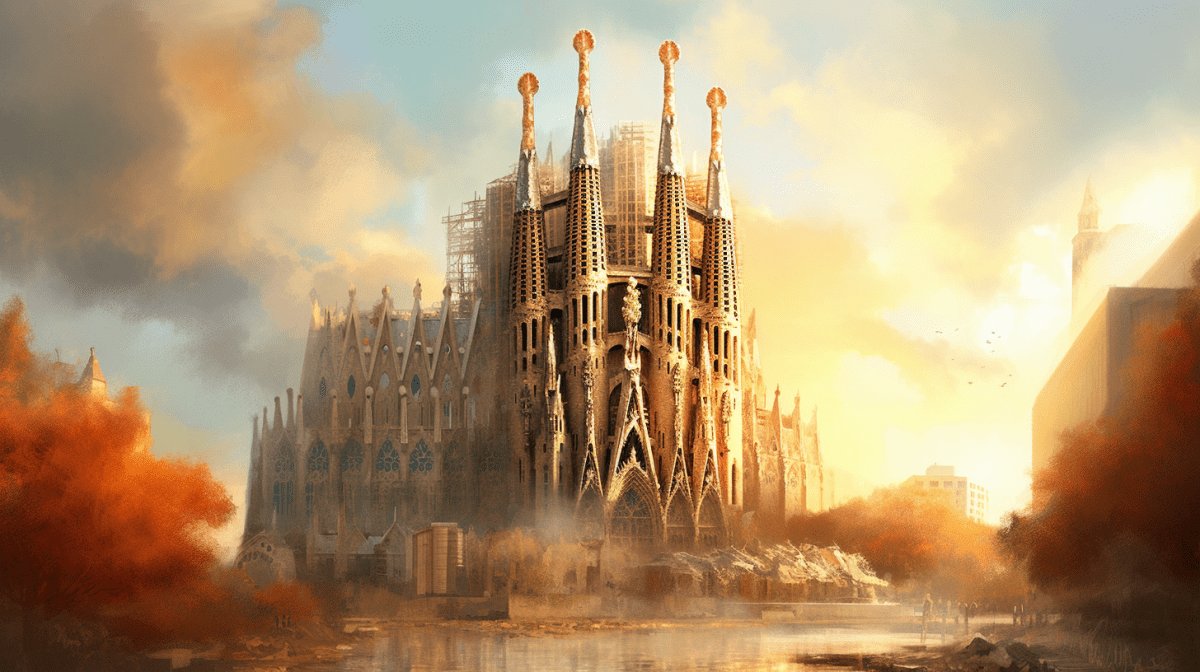
Designing for long gestation periods
A few months ago, I had the privilege of visiting Antoni Gaudi’s Sagrada Familia in Barcelona. The basilica is a remarkable project by any metric, but the part I found most impressive was not the building’s daring combination of styles or its brilliant engineering, but the degree to which the (nearly) final product has…
Keep reading
Specified scale, and efficient communication
One of my favourite takeaways from architecture school has been the concept of drawing to specified scales. In 3D design software, it’s common practice to create models using 1:1 full sized units. Since you can zoom in as much as you like, it’s impossible to run out of space. I’ll never forget how confused…
Keep reading
Infinitely adaptive text: How AI will redefine the relationship between reader and writer
The rise of generative AI has sparked a lot of debate about its potential impact on writing, but the influence it may have on reading has remained largely undiscussed. The more I’ve thought about this, the more I’ve come to believe that adding this second piece to the equation reveals a much more profound…
Keep reading
Texas sharpshooter design
It’s common for busy archery ranges to place several targets on a field at once. Serious archers begin every round by committing to aim for just one of them. Arrows that accidentally hit other targets don’t count towards their scores. A “Texas sharpshooter” refers to someone who does the opposite — firing towards a…
Keep reading
Cognitive load
Cognitive load theory states that the working memory can only hold a few pieces of information at a time. Good car designers know that the vehicle’s interface should take up as little working memory as possible in order to help drivers focus on the road. If a driver becomes distracted by confusing controls, the…
Keep reading
The Universe doesn’t come with an instruction manual
This post gets pretty existential. If you’re willing to indulge me, read on… Science can illuminate the laws of physics and the facts of matter and energy, but as philosopher David Hume points out, there’s no way to extrapolate this knowledge into a set of moral truths. We can measure what the universe is,…
Keep reading
Will you embrace the human project?
Ecologists love to praise nature’s design genius. “If only humanity would stop screwing things up” many of them think — with a certain degree of self-loathing. When your line of work primes you to interpret human history as an unyielding desecration of paradise, that’s an understandable point of view. There’s no question, we’ve caused…
Keep reading
Breaking the circle of blame
Citizens blame architects for designing lousy buildings. Architects blame developers for prioritizing profit. Developers blame lawmakers for creating market conditions. Lawmakers blame citizens for supporting short-sighted policy. So where does the buck stop? In complex or circular systems there’s often no clear answer — and this creates an opportunity for people who care to…
Keep reading
Are you a designer?
The answer has little to do with your job title. Designers are people who make a point of interacting with the world in a way that creates deliberate change. If you’ve ever planned a meeting, watered your garden, or helped someone smile, you’ve engaged in design. These may be examples of small interventions, but…
Keep reading
What is design anyway?
Some people think it’s how something looks. Jony Ive says it’s how something works. I believe design is a quality we imbue in the things we create with intent. If something we’ve made serves a clear purpose… If it benefits a defined group… If the details at every scale align to support a common…
Keep reading Designable.blog