
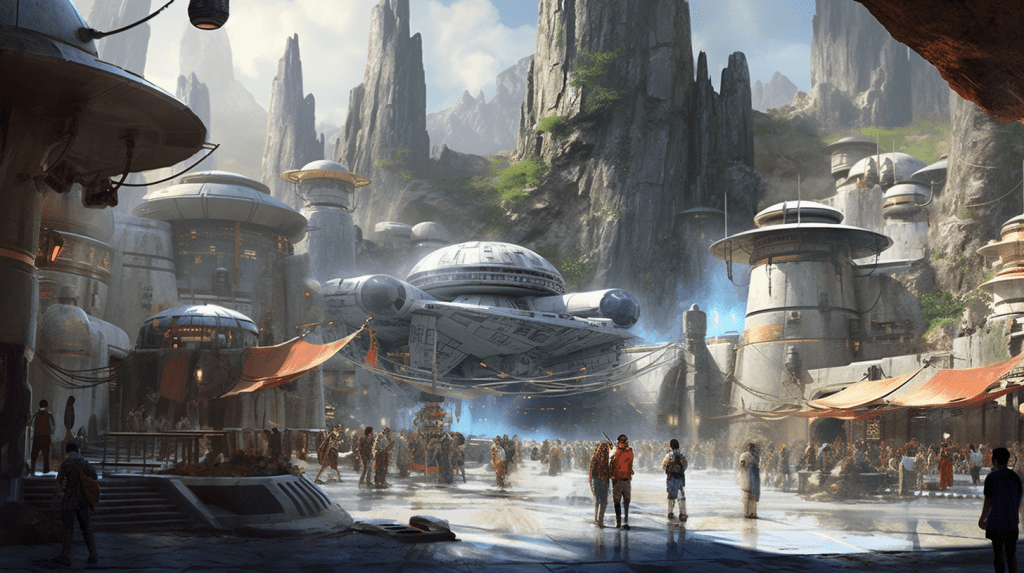
Environmental storytelling is a technique used by theme park designers to create immersive worlds where “the audience” discovers narratives through independent exploration of 3D environments. Notable examples include Disney’s Star Wars: Galaxy’s Edge and Universal Studios’ The Wizarding World of Harry Potter. While this art form can be incredibly engaging, it currently has limitations in terms of depth, narrative coherence, and connection. Thankfully, generative AI may soon offer significant improvements in these areas, transforming the experiences of theme park guests.
Although this discussion focuses primarily on physical theme parks, many of the concepts are equally relevant to digital spaces, like console video games and virtual reality.
Environmental storytelling is distinct from other forms of storytelling, like literature and film, in that it presents narratives in 3D space, engages all our senses, involves the audience as characters, and unfolds non-linearly.
Theme parks have already achieved impressive results in the spatial and sensory aspects of environmental storytelling. For example, The Wizarding World of Harry Potter showcases authentic-looking buildings and objects, and the attention to detail extends to all the smells, sounds, and tastes within the park. The opportunity for improvement lies in audience involvement and non-linear storytelling, and this is where AI can make a significant impact.
A challenge faced by current theme park experiences is the feeling that the rides and attractions follow a predefined path. For instance, the new Spiderman ride at Disney’s Avengers Campus allows guests to “help” Spiderman by slinging webs at robot spiders, but the outcome of the story remains the same regardless of the guests’ performance. Similarly, pre-recorded character dialogues feel generic and one-directional due to their inability to respond to individual guests’ questions or actions.
As AI technology advances, generative text, text-to-speech, and computer vision will likely enable animatronic characters in immersive experiences to become more life-like and engaging. Such characters could dynamically respond to audience input in various contexts, from character meet-and-greets to mid-ride interactions.
This technology could be applied in simple yet charming ways, like allowing moving paintings in a haunted mansion attraction to engage guests in context-building conversation while they wait in line.
More ambitious applications of AI could help create greater narrative continuity between experiences, addressing the challenge of non-linear storytelling. For example, imagine an animatronic Iron Man congratulating a guest on their performance in the Spiderman ride, creating a personalized and interconnected story. A park-wide AI system could facilitate thousands of such personalized storylines simultaneously.
Peering further into the future, generative video AI could play a significant role. If photorealistic videos can be generated in real-time, entire immersive dark ride sequences could adapt to guest input and previous interactions. Simulator rides like the Millennium Falcon could offer entirely unique stories for each guest, preventing boredom and accommodating diverse audiences. AI-generated dialogue, story arcs, soundtracks, and ride-system programming could work in concert to completely reinvent what a given attraction is capable of.
The design process behind environmental storytelling will likely shift from controlling the entire experience to collaborating with AI. Designers and storytellers will need to communicate their thematic intentions to AI models and ensure that AI-generated content aligns with their vision. The challenge will be to create a balance between digital flexibility and physical permanence while considering how multiple storylines can unfold simultaneously without confusion.
As we look towards the future of environmental storytelling in theme parks, it’s clear that generative AI will play an increasingly important role in creating immersive experiences that truly engage guests on a deeper level. With the ability to personalize stories in a non-linear environment and create dynamic interactions between characters and guests, the potential for generative AI to transform the theme park experience is enormous. As the technology continues to improve, it’s exciting to think about the possibilities that lie ahead.
 Designable.blog