
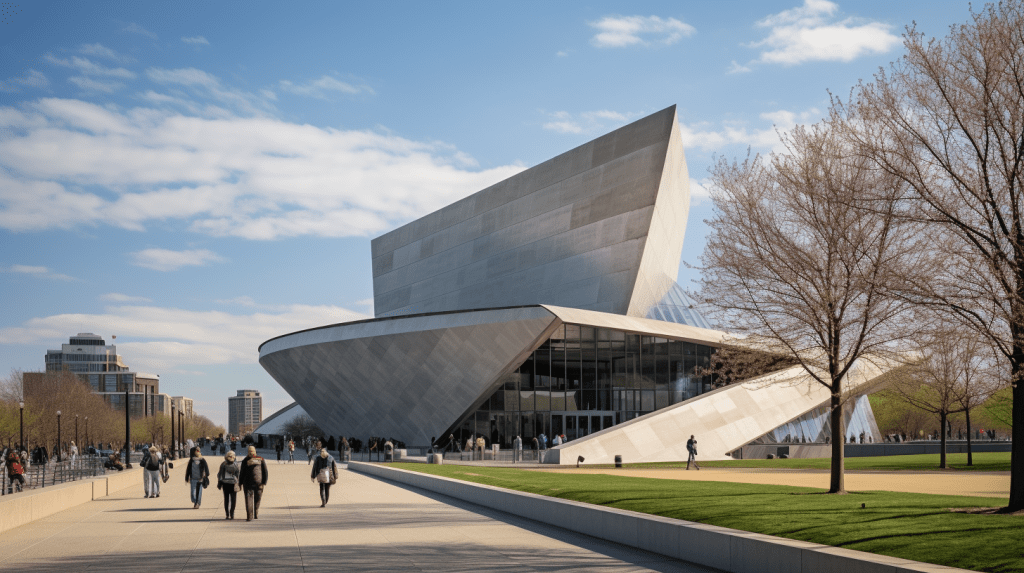
Last week I had the opportunity to visit some of the extraordinary Smithsonian museums in Washington D.C.
One of the big takeaways for me was the fact that our experience of architectural space has a huge effect on our ability to make meaning out of information.
When the internet came along, I think a lot of people probably wondered if the concept of the museum would survive. After all, there’s generally nothing a museum can tell you that can’t be found online.
What I think we’ve discovered however is that a museum that’s been well designed has the power to deliver an emotional experience that builds comprehension and memory in a way that two-dimensional media cannot.
I’ve been aware of the story of slavery in broad strokes since I was in elementary school, but the African American Museum (NMAAHC) allowed me to feel the story in a far more visceral way. Its use of compression and expansion, light and dark, quiet and loud, hot and cold, rough and smooth, help the visitor build a form of understanding that I don’t think is otherwise possible.
There’s a reason why the “memory palace” technique is so popular among memory competition participants. Relating facts and concepts to space helps the brain store, link, and contextualize information more effectively.
The unfortunate thing about museums is that they’re incredibly expensive to build, and usually inconvenient to visit. They’re also essential because they’re often fundamentally superior tools for communicating stories and complex ideas.
Over the last year or two, the hype around an embodied, spatial internet (aka the metaverse) has faded a little bit, but I think as the technology improves, it’s reasonable to expect we’ll see quasi-metaverse style experiences become commonplace sooner or later. If that’s the case, It seems there’s a big incentive for the design industry to become better versed in this spatially enriched form of communication. It’s going to become much less expensive, and I think the opportunities to put it to good use abound.
I’m not suggesting that everything we write or share needs a full-on museum treatment — that sounds exhausting — but I can definitely imagine a spectrum of applications that taken together could really change the way we process ideas and learn.
 Designable.blog